
Gerald Bull is in many ways a tragic figure, whose single-minded pursuit of a cannon that could launch satellites into space led to growing ethical compromises—and eventually his assassination.
For many decades, humans have flirted with the idea of using giant cannons to send projectiles into space. The notion was notably depicted in a Jules Verne novel, From the Earth to the Moon, in 1865; Verne’s novel was groundbreaking in that the French novelist attempted to perform rough calculations on how much energy such a gun would require, many of which were remarkably accurate. Verne’s novel later inspired the groundbreaking 1902 silent film A Trip to the Moon, which was somewhat less realistic.
By the mid-20th century, the idea of a “space gun” had crossed from speculative fiction into the domain of engineering. Though the concept sounds far-fetched, it is theoretically sound: using a single ground-based explosion to propel a projectile into orbit is potentially a far cheaper method of payload delivery than a rocket continuously burning fuel on its way up. On the flip side, there are good reasons that such a gun has never been built—chiefly the prohibitive upfront costs of building the cannon, the need for the payload to withstand a sudden acceleration of thousands of Gs, and the problem of atmospheric drag on the projectile. It remains an interesting idea, and several startups are working on the problem—although interest has waned amid Elon Musk’s recent successes with rocket recovery, significantly lowering the cost of using rockets.
Much of the work on a modern “space gun” is derived from the research and innovations of one man: a Canadian aeronautical engineer named Gerald Bull, who dreamed of using a huge cannon to economically launch satellites and other payloads into space. Bull’s life is worthy of a Shakespearean tragedy; a brilliant but irascible engineer, his scientific zeal and desire to see a functioning space gun led him to make a series of increasingly unethical decisions in single-minded pursuit of that goal. Ultimately, a combination of politics, national security concerns, and international diplomacy doomed his project—and cost him his life.
Gerald Bull: The Most Dangerous Canadian in History
Gerald Bull entered the University of Toronto in 1944, at the age of 16. He studied aeronautical engineering, where his academic record was described as “strictly average.” Nevertheless, Bull went on to earn his PhD from the University of Toronto in only three years, finishing at age 23—a record that still stands as the youngest in the university’s history. His master’s thesis and doctoral dissertation dealt with advanced wind tunnels, one of which he designed and built with a fellow graduate student. While finishing his PhD work in the early 1950s, Bull took a volunteer position at the Canadian Armament and Research Development Establishment (CARDE), which studied and experimented with artillery and ballistics in cooperation with the US military.
Bull became a full-fledged staff member at CARDE after he completed his doctoral work. He and some graduate students built a Mach 4 wind tunnel from scrap in 1954 for only $6,000. Bull then used his own department’s money to fund a program to create a telemetry system that could fit in his models.
Bull then turned his attention to high-velocity anti-ballistic missile guns, which drew interest from the US Army. But he grew disillusioned with government bureaucracy and red tape and became scornful of politicians who he believed had no vision. He resigned from CARDE and took a professorship at McGill University in Montreal, where he continued his research independently.
In 1961, Bull suggested that guns could be used to economically loft missile components to study re-entry characteristics. The resulting High Altitude Research Project (HARP) used a repurposed US Navy 16-inch battleship gun. The gun performed so well that the project expanded, basing the guns and 300 staff on the island of Barbados. HARP is generally seen as the high point of Bull’s scientific career; running until 1968, it was viewed as a success and was praised in the United States and Canada, supported by the government of Barbados for the educational opportunities it gave to aspiring Barbadian engineers, and proved invaluable for collecting high-altitude atmospheric data—still representing a large portion of what we know about upper-atmosphere performance even today.
To Supplement His Space Project, Bull Became an Arms Dealer

Having reached the edge of space, Bull now dreamed of going all the way. He wanted to use a similar, even bigger gun to launch payloads into orbit.
Bull used his remaining HARP assets to launch the Space Research Corporation, an early space gun startup. To fund that ambition, however, SRC became an international artillery consultant, and Bull began to redesign cannons to fire farther and more accurately—effectively transforming SRC from a scientific endeavor into an arms dealer. Although Bull regarded this as a side project, it was what paid his bills, and his success at it begat further involvement.
At first, the consequences were positive for SRC. By 1973, it was selling superior artillery ammunition to Israel, which allowed long-range counter-battery fire against Soviet-made rockets being fired from Lebanon. Bull’s assistance to Israel prompted an Act of Congress that granted him American citizenship and a high-level nuclear security clearance.
SRC’s success continued with Bull’s GC-45 howitzer, offering significantly longer range than that of existing guns, even those designed for long-range fire. But Bull overstepped in 1976 after he sold the GC-45, its plans, and its ammunition to South Africa, which was then under an international arms embargo. He also sold technology pertaining to long-range artillery shells to China without the required export permits. As a result of these two deals, Bull was charged with sanctions evasion, and pleaded guilty with the expectation of a minor punishment. He was fined $55,000 by Canada for the China export violation, but spent six months in US federal prison for the South Africa deal, a far harsher sentence than he had anticipated. The experience soured Bull on the United States, and after his release from prison, he moved to Europe, never to return.
Shunned by the West, Bull Started Working for Saddam Hussein
Bull re-established his space gun project in Brussels, Belgium. It was there that his dream of a super gun first appeared to have a path forward.
That path came in the form of an offer from Iraq, where newly-inaugurated dictator Saddam Hussein wanted Bull to upgrade his artillery for use in the ongoing war with newly-revolutionary Iran. Bull also discovered that Saddam was pursuing a space program, in which his super gun might play its intended role. That opportunity may have been more enticing for him than the lucrative arms contract.
Working with Saddam in the early 1980s wasn’t really controversial; nearly every nation in the world supported Iraq, even as many were reluctant to admit it publicly. Israel was the only nation especially wary of Saddam, eyeing the Iraqi despot’s nascent nuclear and space efforts with suspicion. Indeed, in 1981, an Israeli Air Force surprise raid knocked out Saddam’s unfinished Osirak nuclear reactor that same year, sparking rebukes from the United States and the United Nations.
Bull’s work was not nuclear-related, so he was unaffected by these developments. Even so, he was casting his eyes around the world in a more mercenary fashion to pursue his own goals. Nicholas Hall, Keeper of Artillery at the United Kingdom’s Royal Armouries, noted that Bull was “slowly alienating himself from the Western world.”
About Iraq’s “Project Babylon” Supergun
As before, Bull’s work with artillery was a success, and won him favor from Saddam. In 1988, the Iraqi government expanded his contract to include “Project Babylon,” an attempt to finally build his space gun. The initial investment was $25 million—but included the stipulation that Bull continue his work with Iraq’s artillery arsenal, as well as improving the aerodynamics of Iraq’s Scud missiles.
The project initially planned three high-velocity super guns known as “Big Babylon” and “Baby Babylon.” Big Babylon’s 1-meter bore barrel was to be 156 meters (512 ft) long, with the entire gun weighing 1,664 tons. The gun’s size meant that it would be stationary, and though Bull seems to have designed a supporting framework, the final plans had it mounted at a 45-degree angle on a hillside. “Baby Baylon” was a prototype designed with a 45-meter-long, 350mm bore and would have been proportionally smaller than Big Babylon. Testing reportedly established its range at roughly 750 kilometers (466 miles)—in principle far enough to put a projectile into orbit.
The guns were never completed, but their projected performance specifications are impressive. Big Babylon would use a 9.92-ton propellant charge capable of firing a 600 kilogram (1,323 pound) projectile to a range of 1,000 kilometers (621 miles). Employing his background in missile technology, Bull calculated that Big Babylon would also be able to launch a 2,000 kilogram (4,409 pound) rocket-assisted projectile carrying a 200 kilogram (441 pound) satellite into orbit. The projectiles would use the sabot technology Bull developed while at CARDE to protect them from the initial muzzle blast and acceleration.
If it had been completed, Big Babylon’s satellite launch capability would have been far more economical than rocket technology. NASA estimated in 2016 that launching a modern satellite into orbit costs some $22,000 per kilogram. Musk’s rocket recovery program has since reduced that cost to the mid-thousands of dollars per kilogram, since certain components can be reused. But Bull’s cannon could have done the job for as little as $1,700 per kilogram, a fraction of the cost—assuming the contents of the package could stand up to the massive G-forces involved.
Bull’s Refusal to Quit Led to His Assassination
Iraq’s neighbors quickly became alarmed at Project Babylon’s military potential. Its proposed location put Iran and Kuwait within its range, and the technology was potentially scalable, meaning its range could one day be extended to Israel as well.
Bull was aware of those concerns, but stressed that the supergun was essentially useless as a weapon. For one thing, it was stationary and could not be moved: it could only fire in one direction and could not be retargeted. It was also very slow to fire, and generally inefficient as a military cannon. Finally, it would have been impossible to hide, since it would have set off seismic alarms similar to a nuclear explosion upon firing. Big Babylon’s estimated recoil would have generated nearly 30,000 tons of energy. The cannon’s immobility, and its enemies’ ability to easily pinpoint its location, made it extremely vulnerable to attack.
Unfortunately for Bull, the political climate of the time did not support a nuanced view of the cannon’s capabilities. General Hussein Kamel-al-Majid, an Iraqi defector who cooperated with the UN, indicated that Saddam thought of the cannon as a superweapon. Al-Majid claimed that Iraq sought to develop the capability to fire the gun at long-range terrestrial targets, including nuclear strikes, probably through some kind of guided missile technology. Saddam also planned to use it as an anti-satellite platform; shells had reportedly been designed to explode in space near the target satellite, spraying it with a sticky substance to blind it.
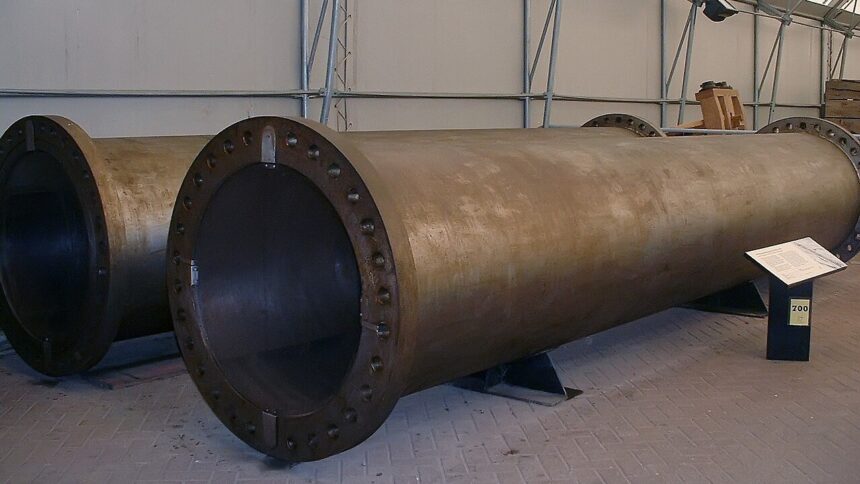
These ambitions were mostly delusional, and there is no evidence that Bull was aware of them, let alone that he was actively working on them. But they led the West to take action to inhibit the gun’s progress. Big Babylon’s components had been ordered from various European firms, including the barrels, which were made by Sheffield Forgemasters in the UK. European governments seized the components after Saddam’s August 1990 invasion of Kuwait. The Royal Armouries have sections of the confiscated barrels on permanent display at Fort Nelson, along with an example of Bull’s GC-45 howitzer.
Bull himself did not live to see the end of his project. On March 22, 1990, he was shot five times as he was entering his Brussels apartment. The killer was never caught or identified. Bull had reported previous break-ins, and some speculate that those may have been warnings to discontinue his work for Iraq. The police found Bull’s keys still in the apartment door, and his briefcase, which contained $20,000 in cash, was untouched; robbery was clearly not the motive.
Hard evidence regarding the assassin’s identity has never come to light, and various conspiracy theories have blamed the US, UK, South Africa, and even the Iraqis themselves for Bull’s murder. But the consensus points to Israel as the most likely culprit, given its particular concerns about Bull’s work on Iraq’s Scud missile program. Indeed, during the 1991 Gulf War, Saddam turned Bull’s improved Scuds against Israel, killing dozens of Israelis and injuring hundreds more. That number is almost certainly higher as a result of Bull’s design work on Iraq’s behalf—a tragic postscript to a lifetime of remarkable scientific achievement.
The Space Gun Idea Isn’t Dead
Subsequent theoretical work on space guns continued, showing that they are indeed a viable technology. But they remain theoretical, as the energy seems to be flowing into traditional rocket technology. Prospective entrants into the sector will also need to compete with Musk’s SpaceX titan; Musk himself has shown little interest in the project, in part because it would undermine his longstanding rocket work.
But space guns remain a future possibility. Nations looking to establish a space program may yet see Gerald Bull’s vision realized, as might current players who wish to cut costs. The space race certainly isn’t going away, and the space gun may yet play a role in its advancement.
About the Author: William Lawson
William Lawson is a military historian focusing on World War II and 20th century conflicts and the American Civil War. His specialty is operational level warfare, especially American amphibious doctrine. He writes on history, politics, and firearms for multiple publications and historical journals. He serves on the editorial advisory board for the Saber & Scroll Journal and Military History Chronicles and is a member of the Society for Military History and the American Historical Association. Lawson is based in Virginia.