

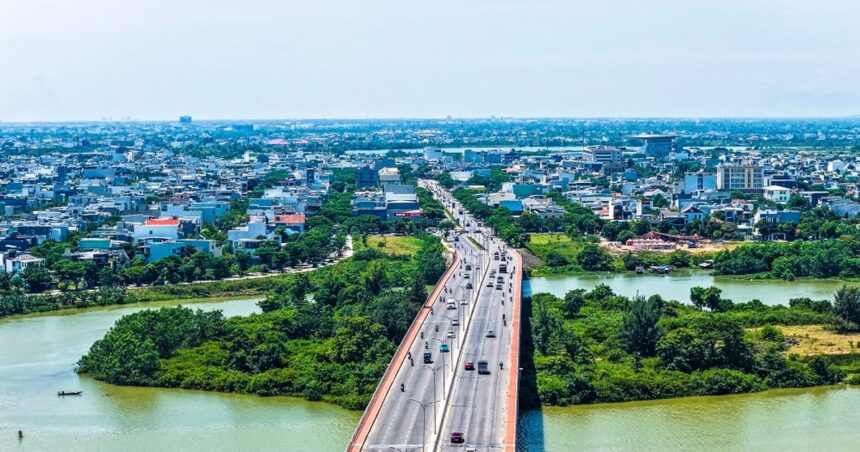
Da Nang is facing a broader development space with new impetus from the digital economy , free trade zones, and international financial centers.
This spirit raises a particularly significant issue: Opportunity only truly becomes a driving force when it is transformed into better governance, stronger creativity, and a higher quality of life for the people.
New management capabilities
What is noteworthy about the spirit of the 3rd Central Committee Conference is not only the grand objectives, but also the very practical way in which issues are framed regarding the country’s development in the new period.
The required policy decisions must bring about qualitative shifts in the operational quality of the system, unified management of development space, establishing a growth model increasingly based on productivity, knowledge, technology, and human resources, while enhancing the ability to prevent and adapt to unpredictable changes.
This approach shows that we are gradually shifting from a mindset of structural change to one of creating new capabilities from the very structures that have been changed. In the context of Da Nang , this requirement becomes even more significant.
The new area brings together a system of seaports, international airports, high-tech zones, open economic zones, industrial parks, along with unique resources in tourism, culture, heritage, and ecology.
This is a huge foundation for development, but larger scale only truly becomes valuable when it creates better connections between resources and fosters a management mindset appropriate to the space.
Therefore, Da Nang today cannot be viewed simply as the sum of two former administrative boundaries.
The city needs to be recognized as a new, developing entity, in which urban areas, seaports, industries, and high-tech sectors are connected with heritage spaces, tourism, agriculture , mountainous areas, and border trade to create value chains that can complement each other.
The city’s orientation after the merger also emphasizes the need to comprehensively leverage new advantages, building Da Nang into a highly competitive growth hub for the nation and the region.
Thus, the greatest significance of spatial expansion lies not in gaining more land or population, but in the ability to reorganize resources more efficiently.
In that spirit, particular attention is paid to the three questions posed at the 3rd Central Committee Conference regarding each policy decision: What bottlenecks need to be removed, what new capabilities need to be created, and what conditions are necessary for effective implementation?
Those three questions are also very relevant to Da Nang as the city is implementing new development drivers such as the Free Trade Zone and the International Financial Center. The Free Trade Zone is being oriented towards being linked with the International Financial Center to attract high-quality capital flows and create new growth drivers.
Therefore, what is important is not just having a new model, but what value that model creates for the economy, what types of businesses it attracts, what technological and service capabilities it develops, and what opportunities it opens up for local businesses and workers.
To turn opportunities into tangible results, execution capability remains the decisive factor.
Decentralization and delegation of power need to be further promoted, but they must be synchronously linked with authority, resources, data, tools for implementation, and control of power, as required in the conference agenda.
A dynamic government is not simply one with more power, but one that is capable of making quick, lawful , transparent decisions and is ultimately accountable for the results.
When responsibility and authority converge at the same address, avoidance and buck-passing can be reduced, and a spirit of boldness and initiative can flourish.
The goal of development must ultimately return to people.
A very significant point in the spirit of the 3rd Central Committee Conference is the placement of people on par with knowledge and technology in the new development model.
.jpg)
This shows that high growth targets cannot continue to rely primarily on expanding investment capital, exploiting more resources, or using cheap labor, but must increasingly rely on productivity, innovation, and the quality of human resources.
For Da Nang, a city strongly oriented towards the digital economy, high technology, finance, and high value-added service industries, this requirement becomes even more urgent.
Da Nang aims for the digital economy to contribute 27% to its GRDP by 2026 and has identified several groups of solutions to develop not only the core information technology sector but also the digital economy in various industries, sectors, and platform models.
However, technology only becomes a powerful force when there are people capable of mastering it, innovating, and transforming it into new productivity, products, and services.
Therefore, in addition to transportation infrastructure, port infrastructure, free trade zones, and digital infrastructure, Da Nang needs to pay special attention to another type of infrastructure: “human infrastructure,” with a good education system, research centers, a startup ecosystem, a team of experts, engineers, creative entrepreneurs, and a truly attractive environment for talent.
This is also where Da Nang can create its own competitive advantage. The city doesn’t necessarily have to compete with larger centers just on scale, but can compete through quality of life, a creative environment, openness, and a humane urban culture.
The concept of a “livable city” therefore needs to be broadened in this new phase, encompassing not only clean, convenient, and attractive cities for tourists, but also places where young people see career opportunities, talented individuals feel valued, children have opportunities for development, the elderly are cared for, and remote communities have increasingly equitable access to development opportunities.
This is all the more important given the diverse landscape of Da Nang, encompassing coastal cities to mountainous regions, and areas ranging from industrial and service centers to those still facing significant challenges.
Rapid development must therefore go hand in hand with inclusive development, so that the benefits of growth are not concentrated in a few favorable areas but are spread more widely.
A new road project should be evaluated not only by the scale of investment but also by the communities it connects; an industrial project should not only be judged by the registered capital but also by the quality of jobs created and the ability to transfer technology; a tourism product should not only be measured by the number of visitors but also by the value created for the community and its ability to protect heritage, culture, and the environment.
Along with rapid development, Da Nang also needs to pay special attention to its resilience against increasingly complex changes.
The 3rd Central Committee Conference emphasized the need to shift from addressing individual risks to proactive prevention, enhancing the ability to adapt to geopolitical conflicts, climate change, data security, and artificial intelligence.
For a coastal city with an open and increasingly integrated economy, resilience must be demonstrated through a diversified economy, infrastructure capable of adapting to natural disasters, a secure data system, a government with predictive capabilities, and a community strong enough to overcome difficult times together.
Ultimately, Da Nang’s greatest opportunity today lies not only in the city’s increased space, population, special mechanisms, or large-scale projects.
The more important opportunity is to rethink our development model, so that from a new space we can create new governance capabilities, a more innovative economy, and a more cohesive community.
When every final decision is measured by whether people have more opportunities, a better life, and feel proud of where they live, then the aspiration to build a modern, dynamic, and livable Da Nang will truly have a sustainable foundation.
Source: https://baodanang.vn/bien-co-hoi-thanh-dong-luc-3347905.html